Sunday, June 5, 2011

Pigs on Pasture!

The pigs are grazing, rooting, sniffing, and exploring their new pasture. They are so happy I can't describe it in words. As soon as I released them from their temporary training pen, they started eagerly exploring the whole area and soon were running and running all over the place. Its a truly beautiful sight.

Transitioning the pigs to pasture took some planning and preparation, but in the end it went very smoothly. After I got their A-frame situated in the field, I built a temporary pen for electric fence training. I pounded some U-posts into the ground and then just built up some walls with skids and old boards. It was not very pretty, but it was easy to set up and it served its purpose.

I built three sides of the pen and then set up the electric netting as the fourth wall. Then I set up more boards on the other side of the netting. This is the secret to training pigs to the fence. Pigs don't have the best eyesight so the thin strands of the netting are easily missed. Putting up a physical barrier behind the net serves two purposes. It helps them see the netting better and it prevents them from barging through the netting in panic when they first get shocked, which is often their instinctual reaction.


When the day finally arrived for the big move, I put up some temporary plywood sides on the bed of my pick-up truck and filled it with hay. Then I backed it right up to their pen in the barnyard and my dad positioned himself in the truck while Gallagher and I caught the piggies one by one and handed them up to him. Gallagher used a 4x4 piece of plywood to help herd the pigs into a corner and then I swooped in and grabbed a hind leg. The pigs are about 50 lbs. now I would guess--I won't be able to pick them up pretty soon! Picking them up by the a hind leg is the best way to do it. It doesn't hurt them and they don't struggle very much as soon as you have them in the air, but they do scream. They're not in any pain, but they scream bloody murder. Its so loud it really does hurt your ears. And then the second you set them down on their feet again and let go, they stop.

We got them all in the truck very quickly and they stood calmly for their slow ride out to pastureland. We backed the truck up to the pen and did the exact opposite maneuver. All of them got a shock from the fence within seconds of exploring their new space and quickly learned to avoid that wall as they went about ripping up the grass and rooting around for bugs.


Soon they were right at home. They were in the pen for two days to make sure they had been trained, then this morning I took down the walls and let them roam. As they explored the paddock, just like the raptors in Jurassic Park, they each tested the fence in a few places, got a shock, let out a brief yelp, and scurried back in the other direction. What smart pigs! I'm so proud of them.

Tuesday, May 31, 2011

Readying the Field

This last week has been pretty brutally hot, sunny and humid - it's summer time! It feels good to be dirty and sweaty after so many months of staring out at the field waiting.

At the same time, I'm realizing that I should have worked a little harder to get myself in shape this winter.    We laid down black plastic mulch the other day over the bottom 6 rows in the garden. That's where we're planning on planting the tomatoes, pepper and eggplants, and the black plastic warms up the soil and suppresses weeds. After a full day of bending, standing and squatting my legs were screaming.

The black lines along the rows are drip tape, part of the irrigation system we bought at Brookdale Farm in New Hampshire. Each row has a line of tape that will slowly drip water throughout the day. They all connect at the end of the rows to a main line that we'll run down the side of the field and will hook up to a garden hose. This system uses much less water than hand watering would and will save us a lot of time  and effort.

Rolling out the plastic mulch
We dug a trench and buried it on either side of the row


Notice the drip tape lines going under the plastic
Finished!
Meanwhile, our tomato, pepper and eggplants are hardening off outside, getting ready to be planted tomorrow. We'll just cut a hole through the plastic and put them in the ground. It's good they're going in the ground, they've gotten really big. 


Thursday, May 26, 2011

Hooray, we have a field!


It took two days but the fields are all laid out and we're going to start planting tomorrow!


We made 30 inch rows  (so we can work in them and step over them easily) and 16 inch walkways (16" because that was the size of our biggest rake). The rows curve with the topography of the land because there's a pretty significant slope and we want to catch as much water as possible as it flows downhill. If the rows were straight, a lot of water would just collect in the paths and flow down into the wet area in the middle of the field, but this way the water will collect against the beds and filter slowly through. 


We used a couple different methods for raking the dirt, everyone had their favorite ways to do it, but basically we laid out the 30 inch beds using a homemade "scribing tool" (basically a couple of stakes drilled onto a piece of wood 30" apart)


and then we proceeded to alternate between raking up the dirt on either side and raking it down the middle to create pathways. It was pretty exhausting dirty work, but also very satisfying, the garden is finally coming together and it's so nice to be outside in the sun! We all got sunburnt. 

In a couple of the walkways we put down cardboard and straw to keep down the weeds and create a path. The cardboard we've been getting from supermarket produce boxes and from a bike shop in Concord (bikes come in big cardboard boxes). It's going to be pretty hard to collect enough cardboard to put down on these rows, however, so we're going to plant some in clover instead.  


Our Aerial Shot: from on top of the lumber racks on the back of Dave's pickup


The bottom corner is going to become one big triangular bed, probably for cucumbers. 

It's been a long couple of days but we can finally start planting!


New House for the Pigs

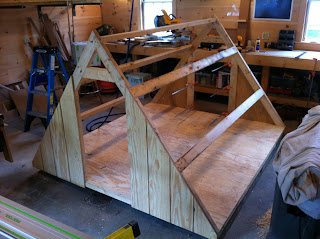
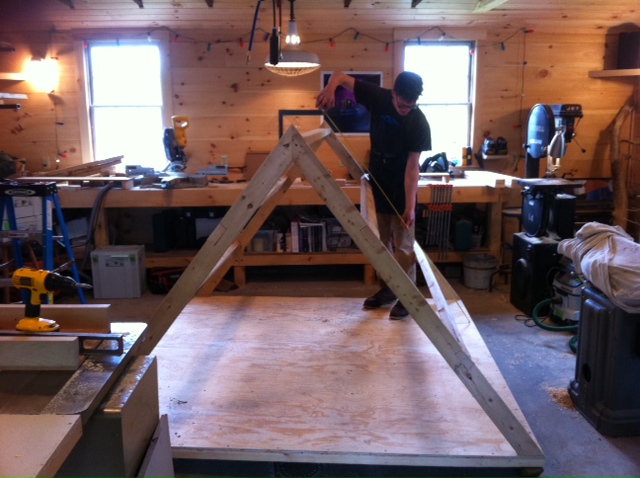
I recently completed the pig's new shelter for when they are relocated onto pasture. I knew that I wanted to build a simple A-frame for them, so I looked around online and found some plans from an extension service from the 60s. This is a very classic design. The only difference is that the plans called for doors, but I decided not to add them because it just doesn't seem necessary. My pigs won't be around in the winter and if at some point I do keep pigs over winter, they probably wont be out on pasture anyway. This is simply the pig's summer home.


My goal was to build the house as inexpensively as possible and to use as many free/recycled materials as I could find. At first I thought it was going to be difficult to get what I needed for free since its all dimensional lumber and sheet goods, but it worked out pretty well. After a somewhat awkward conversation with the lumberyard manager at Littleton Lumber, they took me around back and forklifted down a huge stack of 2x4s and 2x6s for me. They were all recycled and had lots of nail holes and some staples in them. And they were pretty twisted and checked, but there were a lot of long lengths, a bunch of 16' and 12'ers. So I said thank you very much and took the whole stack.


I had 5 sheets of Texture 1-11 plywood which were left over from some project. I found them in the garage and I have no idea how they got there. Texture 1-11 is plywood that somewhat resembles barn boards. Its kind of hokey stuff, but it was free and for this purpose it actually was perfect. It looks nicer than normal exterior plywood at least.


I was really happy with how efficiently I was able to use my materials. I used all 5 sheets of the texture 1-11, with very little scrap left over. The triangularly shaped sections in the pic above were all cut out from one 8' long strip. The only materials that I ended up buying were:

(2) pressure treated 4x4s (for skids)
(2) 4x8 sheets 3/4" exterior grade plywood (for the floor)
(1) galvanized steel ridge roll
screws, glue, and paint

All together, I don't think I spent more than $150.


All the framing I did with drywall screws and then I attached the plywood to the frame with glue and nails (using my new finish nailer). I found this glue that Titebond makes called Interior/Exterior Wood Construction Adhesive which I really liked. You apply it with a caulk gun so its great for these projects when you need to get a lot of glue on quickly.


I took an old can of paint from when the barn was re-painted and got it cloned so the pig house matches all the outbuildings.


I drilled through the skids and installed a loop of chain with 1/2" hex bolts so that the house can quickly be hooked up to the tractor. The house will be moving every month or so with the pigs as they are rotated through the pasture.


And here it is, all the way out at the end of the field! I can't wait to get the pigs out there. I will be setting up the fencing tomorrow, so hopefully I'll be moving the pigs in a few days.

Tuesday, May 24, 2011

Wendell Berry Passage

"Eric Gill sees in this industrial dismemberment of labor a crucial distinction between making and doing, and he describes 'the degradation of the mind' that is the result of the shift from making to doing. This degradation of the mind cannot, of course, be without consequences. One obvious consequence is the degradation of products. When workers' minds are degraded by loss of responsibility for what is being made, they cannot use judgment; they have no use for their critical faculties; they have no occasions for the exercise of workmanship, of workmanly pride. And the consumer is degraded by loss of opportunity for qualitative choice. This is why we must now buy our clothes and immediately re-sew the buttons; it is why our expensive purchases quickly become junk.


With industrialization has come a general depreciation of work. As the pice of work has gone up, the value of it has gone down, until it is now so depressed that people simply do not want to do it anymore. We can say without exaggeration that the present national ambition of the United States is unemployment. People live for quitting time, for weekends, for vacations and for retirement; moreover, this ambition seems to be classless, as true in the executive suites as on the assembly lines. One works not because the work is necessary, valuable, useful to a desirable end, or because one loves to do it, but only to be able to quit - a condition that a saner time would regard as infernal, a condemnation. This is explained, of course, by the dullness of the work, by the loss of responsibility for, or credit for, or knowledge of the thing made. What can be the status of the working small farmer in a nation whose motto is a sigh of relief: "Thank God it's Friday"?


But there is an even more important consequence: By the dismemberment of work, by the degradation of our minds as workers, we are denied our highest calling, for, as Gill says, 'every man is called to give love to the work of his hands. Every man is called to be an artist' (Gill, A Holy Condition of Working). The small family farm is one of the last places - they are getting rarer every day - where men and women (and girls and boys, too) can answer that call to be an artist, to learn to give love to the work of their hands. It is one of the last places where the maker - and some farmers sill do talk about 'making the crops' - is responsible, from start to finish, for the thing made. This certainly has a spiritual value, but it is not for that reason an impractical or uneconomic one. In fact, from the exercise of this responsibility, this giving of love to the work of the hands, the farmer, the farm, the consumer, and the nation all stand to gain in the most practical was: They gain the means of life, the goodness of food, and the longevity and dependability of the sources of food, both natural and cultural. The proper answer to the spiritual calling becomes, in turn, the proper fulfillment of physical need."


-- Wendell Berry, A Defense of the Family Farm


Saturday, May 21, 2011

Rainy Week

Those of you who live in the Massachusetts area can probably empathize with me when I say that this past week has been the absolute worst.

We woke up on Monday morning and realized almost immediately that there was no way we were going to be able to perform the final till on Wednesday, it was cold, rainy and dreary and - according to the weather report - there was no end in sight. Naturally, this realization was followed by a couple hours of moping, finger-pointing and rock-kicking. Why hadn't we paid attention to the weather report and tilled on Friday when it was still sunny and dry? What were we going to do all week in the mud and the rain? Was our summer harvest ruined by one poor decision? Was it a poor decision? What was worse, to till too soon and face the weeds or to be planting our field at the very end of May? And what to do with all those crazy two month old tomato plants overrunning the greenhouse????

Well I'm writing now to say, we did it! We slogged through the muddy, rainy week and now we're pulling ourselves out the other side alive and well (except for a couple of chickens - but that's a story for another post). We planted some more in the kitchen garden, did some Spring cleaning, built a shelter for the pigs and got the tomato plants outside where they're hardening off. Now we're glued to the weather report  hoping it's going to dry out in the next couple of days so we can get our fields up and running and our transplants in the ground. Who knows if we made the "right" decision, or if there even is a "right" decision, but we're forging ahead.

And as the weather improves, so do our moods. I see sun so I've got to get outside, but here are some pictures. 


We're using a couple empty raised beds to keep tomato plants outside. We have wire hoops ready if we need to tarp them against the cold at night.

Flower transplants

Building the pig shelter


Friday, May 13, 2011

Fencing Plot

Here is the plot I made for our electric fencing. I measured all the distances with a 200' tape measure and marked trees that I could use as posts with orange tape as I went. Then, I overlaid this plan onto an existing map of the property that I have.


I forgot to put on the map that the size of the small field is 100'x50'. I sent this into Wellscroft and I'm waiting to hear back on a quote.